How do you want to shop?
Use My Current Location
Loading...
How do you want to shop?
Blogs

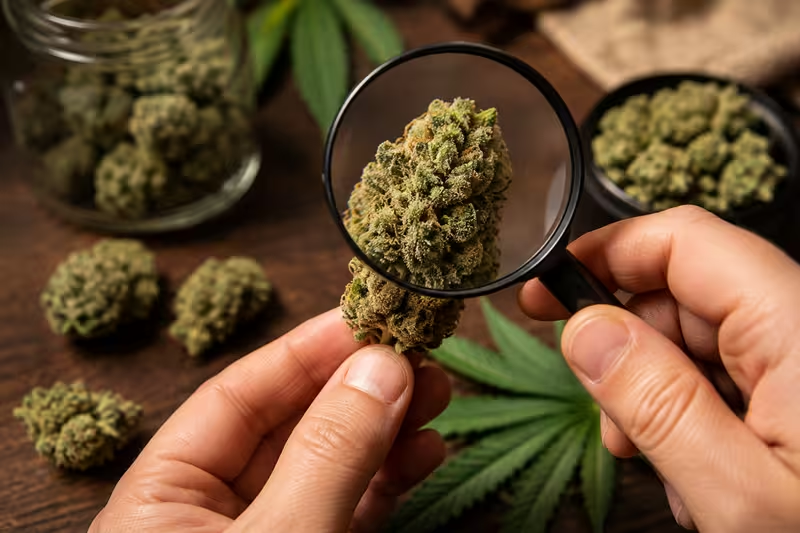
Choosing cannabis flower is easier when you start with what you actually want from the product. Think about the experience you're looking for, your familiarity with cannabis, and the product characteristics that matter most to you. From there, you can compare THC and CBD levels, terpene profiles, strain information, and other details on the label.
There are many cannabis flower options, and the right choice can depend on your personal preferences. You may care most about potency, aroma, flavor, strain type, package size, or price. Knowing what matters to you first can make it easier to narrow down your options.
This guide explains what to compare when choosing cannabis flower and how to narrow your options based on your preferences.
Before comparing strains or THC percentages, think about why you're choosing cannabis flower and what you want from the experience. You might be looking to unwind, feel more social, enjoy a particular mood, or simply explore a new product. Knowing your purpose can help you focus on the product characteristics that matter most to you.
Start with the type of experience or mood you prefer. Some consumers look for flower associated with a relaxing or calming experience, while others prefer products described as uplifting, balanced, or more suited to social settings. These descriptions are not guaranteed, but they can give you a starting point when comparing products.
Your purpose can also influence which details you pay attention to. For example, someone looking to unwind may prioritize a different product profile than someone looking for an uplifting experience or trying to find a familiar aroma and flavor.
If you're looking for... | Consider comparing... |
A relaxing experience | Product descriptions and the overall cannabinoid and terpene profile |
An uplifting experience | Product descriptions and available product information |
A social or balanced experience | Overall product profile and familiar cultivars |
A familiar experience | Strain or cultivar information you've enjoyed before |
A particular aroma or flavor | Terpene information and product descriptions |
Something new to try | Different product profiles and cultivars |
These preferences should help you decide which products are worth comparing, rather than trying to predict exactly how a flower will affect you.
Think About Your Experience Level and Preferences
Your experience level can also influence how you compare flower. If you're new to cannabis, a long list of products and unfamiliar terms can make the choice harder. Starting with a few basic preferences can make the selection process more manageable.
More experienced consumers may already know which aromas, flavors, cannabinoid levels, or cultivars they prefer. You can use those preferences to make your search more specific. Either way, the goal is to compare products based on what matters to you rather than choosing based on a single feature.
2019 study of 2,400 adults in six U.S. states also found that cannabis flower preferences differed across consumers. The study examined THC, CBD, price, and warning information as product attributes and found that users and nonusers did not weigh those attributes in exactly the same way.
This reinforces an important point: there is no universal checklist for choosing flower. Your preferences should determine which product details deserve the most attention.
Instead of choosing the first product that catches your attention, put a few options side by side and look at the information that matters to you. This can help you identify meaningful differences in potency, terpene profiles, cultivars, brands, package sizes, and price.
You do not need to compare every product on a dispensary menu. Start by narrowing your choices based on your preferences, then compare a few products that fit those criteria. For example, if you prefer moderate THC and citrus-forward aromas, there is little reason to compare products that fall far outside those preferences.
When choosing cannabis flower, consider the cannabinoid and terpene profiles alongside the other product details. These profiles can help you identify products that match the potency, aroma, and flavor characteristics you prefer. Looking at both can also help you distinguish between products that otherwise appear similar.
If you already know the THC range you prefer, use it as a starting point when comparing flower. There is no single THC percentage that is right for everyone, so consider your experience and preferences rather than automatically choosing the highest number. You can also check CBD and other listed cannabinoids when products have similar THC levels.
Terpene information gives you another comparison point when choosing between flower products. Research shows that different cannabis flowers can have distinct aroma profiles, which can help consumers compare products based on sensory preferences.
The table below shows some of the product characteristics you can compare:
What you're comparing | What to look for | How it can help you choose |
Potency | THC percentage and other listed cannabinoids | Helps you compare products across your preferred potency range |
Citrus aroma | Lemon, lime, orange, or grapefruit notes | Useful if you prefer bright, citrus-forward flower |
Fruit aroma | Berry, grape, tropical, or sweet fruit notes | Useful if you prefer sweeter or fruit-forward profiles |
Earthy aroma | Earth, wood, herbal, or soil-like notes | Useful if you prefer deeper, herbal profiles |
Pine aroma | Pine, forest, or fresh herbal notes | Useful if you prefer sharper, fresher profiles |
Floral aroma | Floral, sweet, or lavender-like notes | Useful if you prefer softer floral profiles |
Spicy aroma | Pepper, spice, or warm herbal notes | Useful if you prefer stronger, more pronounced profiles |
Flavor | Flavor characteristics listed for the product | Helps you compare options beyond potency |
Related reading: How to Evaluate Cannabis Flower Quality - Learn more about how cannabinoid and terpene information fits into a broader evaluation of cannabis flower quality.
Indica, sativa, and hybrid are common labels used when comparing cannabis flower. They can give you a starting point, especially if you already have a preference for one category. However, these labels do not fully describe a product or guarantee a particular experience.
Research has found that these broad categories do not always reliably predict the chemical profile of cannabis. A study published in Nature Plants found that Sativa and Indica labels did not reliably reflect the overall genetic variation among cannabis samples.
For that reason, use these labels as one part of your selection process. If you have a preferred category, use it to narrow your options, then compare the specific products within that category. This keeps the decision focused on the flower that actually matches your preferences.
If you've enjoyed a particular cannabis strain or cultivar before, its name can give you a useful starting point when choosing your next flower. You can look for the same cultivar or explore related genetics if you want something with a similar background. However, treat the name as a reference point rather than a guarantee that two products will be identical.
The same cultivar can vary between growers, batches, and products. Therefore, check the specific product information before making your choice. If you're trying something new, you can also ask a budtender about similar cultivars based on what you've enjoyed previously.
Brand information can be useful when several products have similar characteristics. Different producers may offer different cultivars, product sizes, price points, and product profiles. However, brand familiarity alone should not determine your choice.
Look at what each brand offers within the specific products you're considering. You might find that one product better matches your preferred THC range, terpene profile, cultivar, or package size. Exploring trusted cannabis brands can also give you a starting point when comparing products from different producers.
Availability can vary between dispensary menus, so the same brand may not always have the same flower options. If you already have a few brands in mind, compare their products rather than comparing the brands as a whole. This keeps your decision focused on the actual flower you're considering.
Package size and price can make a noticeable difference when comparing flower. A larger package may have a lower price per gram, but that does not automatically make it the better choice. If you're trying a new cultivar, a smaller package may make more sense before committing to a larger amount.
A 2025 study analyzed 710,588 cannabis flower products from 3,693 dispensaries across 30 states and Washington, D.C. The researchers analyzed dried flower separately from pre-rolls and found that dried flower averaged $9.05 per gram, with substantial price differences across states. They also found that higher THC levels were associated with higher prices, while larger package weights were associated with lower prices per unit.
Therefore, do not compare the total price alone. Look at how much flower you're getting for that price and compare products with similar characteristics.
The most useful comparison is between products that already meet your basic preferences. Looking at a high-THC flower against a much lower-potency option may not help if you have already decided on your preferred THC range. Instead, compare products that are reasonably similar and then look for the differences that matter to you.
You can create a quick shortlist based on a few factors that matter most to you. For example, compare THC range, terpene profile, cultivar, package size, and price. This gives you a practical way to narrow several choices without having to evaluate every product on the menu.
Product | THC | Terpene preference | Size | Price | Best fit |
Flower A | 22% | Citrus | 3.5 g | $ | Your preference |
Flower B | 24% | Earthy | 3.5 g | $ | Different profile |
Flower C | 21% | Citrus | 7 g | $$ | Larger package |
The goal is not to give each product a perfect score. Instead, use the comparison to see which option fits the factors you care about most. Once you have a shortlist, the final choice becomes much simpler.
If you're unsure how to compare the options on a dispensary menu, a knowledgeable budtender can help you narrow your choices. Tell them what you already know you like or want to avoid, such as your preferred THC range, aroma, flavor, desired experience, or a cultivar you have enjoyed before. If you're new to cannabis flower, simply explain that and ask them to walk you through the available options.
For example, you could say that you prefer moderate THC, citrus aromas, and a balanced experience. You can also ask about details that are not obvious from the menu, such as prominent aromas, flavor characteristics, or similar cultivars. The more specific your preferences are, the easier it is to have a useful conversation about the flower you're considering.
If you have questions about the available flower, you can connect with a knowledgeable budtender at URB Cannabis in Michigan.
You do not need to know every cannabis term before visiting a dispensary. A few straightforward questions can help you compare products and understand your options.
Consider asking:
What flower matches the experience I'm looking for?
What are the THC and CBD levels?
What does the terpene profile look like?
What aromas or flavors should I expect?
What other products have a similar profile?
What package sizes are available?
Are there different price points for similar options?
Asking these questions can make cannabis shopping more straightforward. It also shifts the focus from finding one universally “best” product to finding an option that fits your preferences.
There is no single cannabis flower that is the right choice for everyone. Start with the characteristics that matter most to you, then compare products based on their cannabinoid and terpene profiles, cultivar, brand, package size, and price.
If you're unsure where to start, a knowledgeable budtender can help you compare the available choices. Find a dispensary near you to explore your options at a local URB Cannabis location in Michigan.
Start with your preferences and experience level. Then narrow your options based on the characteristics that matter most to you, such as potency, aroma, flavor, cultivar, package size, or price.
Not necessarily. A higher THC percentage means more reported THC by weight, but it does not automatically make the product a better fit for every consumer.
These labels can help you narrow your choices, but they do not fully describe a product or guarantee a particular experience. Compare the specific product's cannabinoid, terpene, and cultivar information as well.
Terpene information can help you compare aroma and flavor profiles. It can be especially useful when you already know which scents or flavors you prefer.
Should I ask a budtender when choosing cannabis flower?
Yes, especially if you are unfamiliar with the available options. Tell the budtender what you prefer and ask them to explain products that may fit those preferences.
References:
Han, B., & Shi, Y. (2025). Multilevel determinants of cannabis prices in legal markets: Evidence from products sold in nearly 4000 cannabis dispensaries in the United States. International Journal of Drug Policy, 137, 104722. https://doi.org/10.1016/j.drugpo.2025.104722
Isaacson, S. E., Wilson-Poe, A. R., Ye, T., Qian, Y. L., & Shellhammer, T. H. (2025). Beyond potency: A proposed lexicon for sensory differentiation of Cannabis sativa L. aroma. PLOS ONE, 20(10), e0335125. https://doi.org/10.1371/journal.pone.0335125
McKernan, K., Helbert, Y., Zhang, L., Kane, L. T., Sanchis, R., Havas, A., & Kogan, N. M. (2021). Cannabis labelling is associated with genetic variation in terpene synthase genes. Nature Plants, 7, 1330–1337. https://doi.org/10.1038/s41477-021-01003-y
[Author(s) of 2019 study}, (2019). [Title of study on consumer preferences for cannabis flower attributes]. [Journal Name, volume(issue)}, [pages], https://pmc.ncbi.nlm.nih.gov/articles/PMC6893125